Santiago Mostyn | Natural History (Radio Free Grenada)
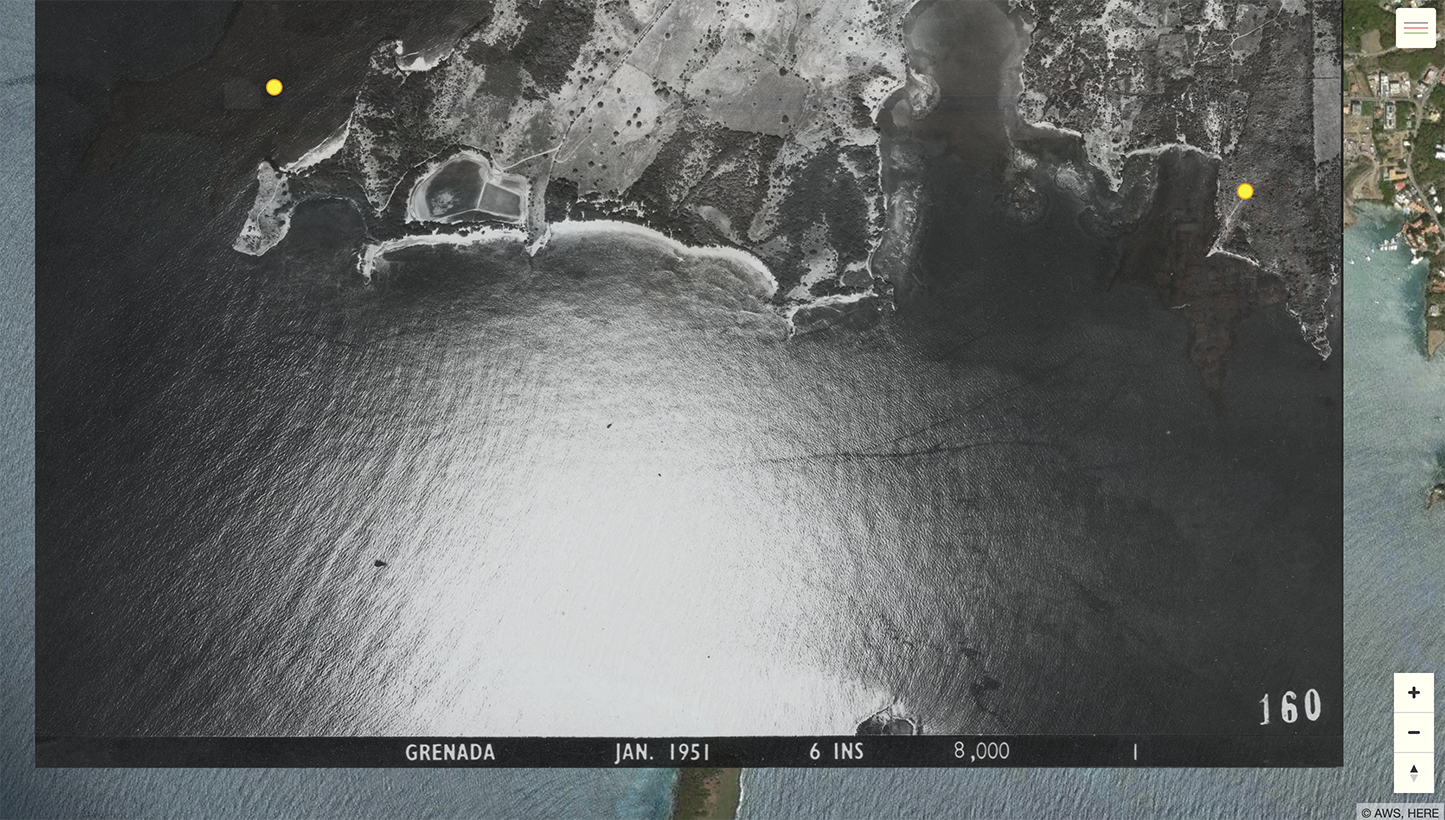
Image: Santiago Mostyn, Natural History (Radio Free Grenada), 2026. Digital commission for Primary, Nottingham. Screen capture of an interactive map showing the coastline of Grenada with markers indicating listening points. Curated by Jade Foster with curatorial support from Ayesha Jones. Courtesy the artist and Primary.
COMMISSION: Digital commission for Primary
DATES: 2026–2036 (10-year digital commission, with potential for extension)
ACCESS THE WORK: Radio Free Grenada interactive map; experience the work via https://freegrenada.radio/.
Santiago Mostyn’s new digital commission, Natural History (Radio Free Grenada), marks the artist’s first solo project in the UK. Taking the form of an interactive digital map of Grenada, the work reimagines historical geography through sound, site and archival encounter. Built around topographical maps of the island from British colonial archives and the present day, Mostyn’s interactive depositary invites movement across place as a mode of listening.
At each map pin—music, oral testimony and radio recordings unfold not as illustration but as material presence. Sound becomes the connective logic, charting political life, everyday rhythms and the sonic formations that shaped revolutionary consciousness across the Caribbean. The project attends to the aesthetics, affordances and limits of digitisation: the tactile imperfection of the analogue map remains visible, and the interface favours listening over viewing. What emerges is not a single narrative, but a constellation of speech, song and site.
Mostyn’s approach values accumulation more than authority. History is seen as anecdotal and embodied, shaped by memory and movement as much as by official record. The artist highlights his own ‘embodied knowledge’ which the commission’s curator says is part of the cultural fight for intellectual sovereignty and leads to the ‘soul choices’ we make, echoing the words of curatorial elder and now ancestor Koyo Kouoh. Alongside archival sound and field recordings, the platform is designed to expand, opening space for historians, archivists and community knowledge holders to contribute. By positioning sound as both archive and cartography, the work reframes how this history is inherited, felt and shared in digital form.
Santiago Mostyn is a British citizen who grew up in postcolonial contexts on both sides of the Black Atlantic—Africa and the Caribbean—and experienced the British-inflected school system from beginning to end. Mostyn’s displacement from Grenada as a child during the US military invasion was a foundational trauma. Before the invasion of Grenada in October 1983, Santiago’s parents lived on the island, teaching in a primary school and working for Radio Free Grenada. His unique perspective, marked by both distance from and deep immersion in the discussion surrounding British identity in the visual arts, has informed his work. This commission represents the culmination of a lifetime spent developing an artistic language centred on themes of belonging and identity.
Access the work
Visitors can explore the platform at their own pace using an interactive map interface.
Natural History (Radio Free Grenada) is an online digital commission available through the Radio Free Grenada interactive map.
The work brings together sound recordings, oral histories and archival material that can be explored by selecting listening points across the island of Grenada.
The digital commission can be experienced online at https://freegrenada.radio/.
Access
Content note
Natural History (Radio Free Grenada) draws on archival recordings and historical material connected to Grenada’s political history, including the Grenadian Revolution and its aftermath. Some audio reflects experiences of displacement, loss, political violence and exile.
For detailed access information, download the Natural History (Radio Free Grenada) Access Guide:
Access Guide – Word document (.docx)
Access Guide – PDF (.pdf)
Please get in touch with admin@weareprimary.org if you have any requests or questions about the project.
Image Description
A black-and-white aerial map of part of Grenada’s coastline. The sea fills the bottom half of the image, and the land is at the top, with small bays and inlets along the shore. Two yellow dots mark listening points on the map. At the bottom, text reads ‘Grenada Jan. 1951’. On the right side of the screen, there is a small satellite map and zoom controls from the interactive interface.
Credits
Santiago Mostyn, Natural History (Radio Free Grenada), 2026, digital commission. Curated by Jade Foster, with curatorial support from Ayesha Jones. Web design by Thomas Bush. Programming by Trisha Khallaghi. Commissioned and produced by Primary, Nottingham. Supported by the Paul Mellon Centre for Studies in British Art. This activity is part of Radical Dreams, a live programme that creates space for an explicit transnational alliance that advocates for climate justice, works against environmental racism, and envisions radical futures that nurture all life. Courtesy the artist and Primary.
Natural History (Radio Free Grenada) forms part of the wider Natural History project. The second phase of this three-part process will culminate in Mostyn’s first UK solo exhibition at Primary in Autumn 2026.

Santiago Mostyn (b. 1981, Turtle Island) is an artist working with film, installation and performance. His practice reflects on cultural exchange and interconnectedness across African diasporic communities. Recent solo exhibitions include Skånes Konstförening, Malmö; Mariakirken, Copenhagen; and Gerðarsafn Museum, Kópavogur. Selected group exhibitions include the National Gallery of Zimbabwe, Harare; Kochi-Muziris Biennale; Stellenbosch Triennale; Blindspot Gallery, Hong Kong; and the 12th Rencontres de Bamako. He was a resident at Akademie Schloss Solitude and the 2024-25 David and Roberta Logie Fellow at Harvard Radcliffe Institute.
Mostyn, in collaboration with Susanna Marcus Jablonski, is currently creating Malmö’s official anti-racist monument, titled Master Narratives, which will be permanently installed in 2026. The project began as a citizens’ initiative in 2019 by local activists to honour victims of a white supremacist serial killer, who was active in Malmö between 2003 and 2010.
Mostyn is a British and Swedish citizen currently living and working in Stockholm.
