Studio A4 | Raisa Kabir
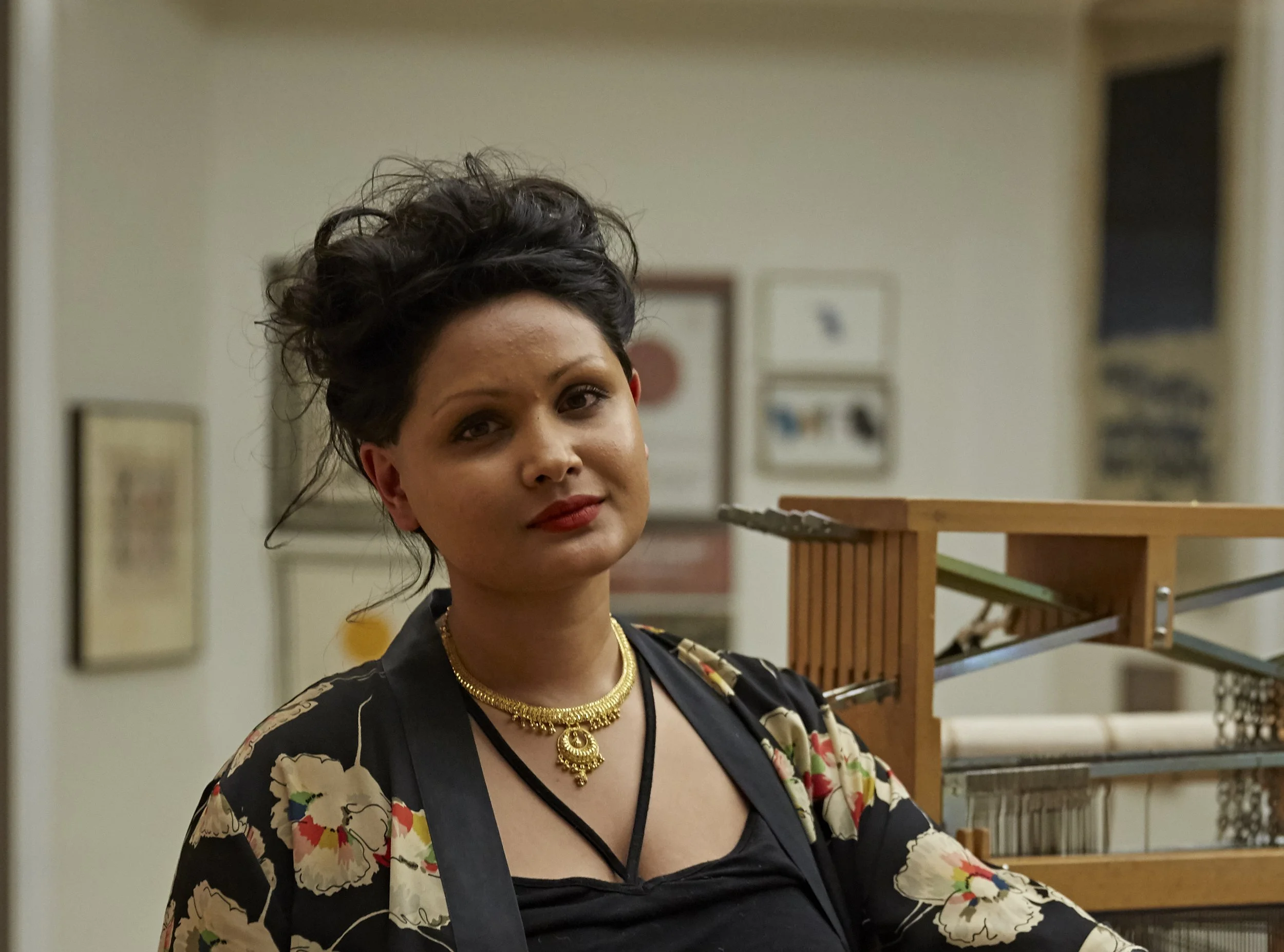
Portrait of artist Raisa Kabir standing beside a wooden weaving loom in a gallery setting. She faces the camera with a relaxed expression and wears a black top with a patterned floral jacket and a gold necklace. The background includes framed artworks on the wall and the structure of the loom visible to her right. Photo by Angela Dennis.
RESIDENCY: 2 – 31 March 2026
Raisa Kabir’s Studio A4 residency at Primary supports the development of new textile-sculpture works exploring queer hybridity through weaving technologies and material histories. Drawing on Homi K. Bhabha’s concept of hybridity, Kabir approaches weaving as a compound structure through which identities, traditions and forms remain in motion rather than fixed.
Current research focuses on Lampas, a complex compound weaving structure used across Asia, the Middle East, China, North Africa and the Mediterranean, particularly during the Islamic Golden Age. In Assam, where Kabir’s research is rooted, related compound structures appear within silk weaving traditions using Muga, Paat and Eri. While Lampas is the Latin term commonly used in museums, the structure is also known as Khinkhwab or Kimkhwab in South Asia and Kemha in Ottoman contexts. Kabir’s work attends to how these layered naming histories shape the ways textile knowledge is transmitted and understood.
During the residency, Kabir is developing a series of large-scale fibrous sculptures that transform ceramic and metal walking sticks into loom-like structures. These works reflect on labour, disability and production through the body, expanding an ongoing enquiry into weaving as both a material process and a political framework. Suspended from the ceiling and cascading towards the floor, the sculptures form a site-responsive installation that extends ideas first explored in The Body is a site of production… resist resist resist! at Yorkshire Contemporary (formerly The Tetley), Leeds.
Research undertaken during the Studio A4 residency contributes to the presentation of new work in Queer Texture at Primary and will inform the development of a forthcoming solo exhibition in Glasgow.
Raisa Kabir’s Studio A4 residency is supported by the Henry Moore Foundation.
Artist Biography
Raisa Kabir is an interdisciplinary artist and weaver based in London. Kabir uses woven text/textiles and performance to materialise multiple concepts, concerning the interwoven cultural politics of cloth. Kabir’s work draws on textile mobilities, embodied archives, and geographies of anti-colonial resistance. Kabir’s (un)weaving performances and tapestries are used to complicate structures of power, global production/extraction, and to call on the weaving knowledge systems and technologies’ potential, to transform, remagine and reweave the current world structures we live under.
Kabir has exhibited work internationally at The Whitworth, Liverpool Biennial, Whitechapel Gallery, Australian Design Centre, Asia Art Now Paris, India Art Fair, Raven Row, The Craft Council London, CCA Glasgow, Archive Berlin, British Textile Biennial, Glasgow International, Textile Arts Center NYC, Ford Foundation Gallery NYC, and the Center for Craft, Creativity, and Design NC.
Kabir has lectured and shared her research at Tate Modern, the V&A, The Courtauld, and the Royal College of Art.