Queer Texture
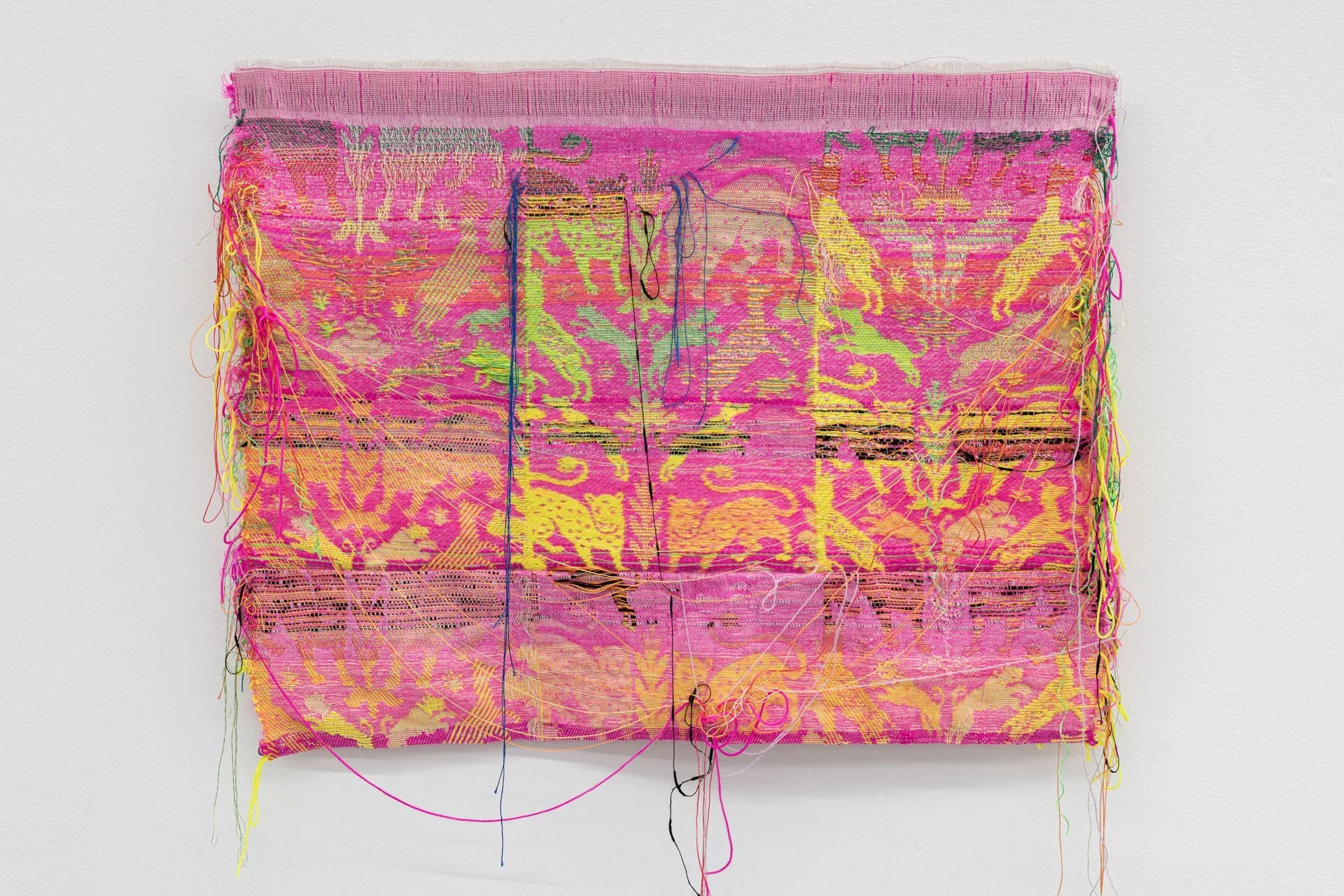
A horizontally oriented textile panel hangs against a plain white gallery wall. The surface is predominantly vivid pink with yellow-green woven motifs arranged symmetrically across the composition, including stylised animals, birds and plant forms. The fabric is disrupted by several horizontal openings that reveal underlying layers. Long loose threads in multiple colours hang from the edges and across the surface, some trailing downward in arcs. A narrow band of lighter pink fabric runs along the top edge. The frayed edges and exposed structure emphasise processes of weaving, cutting and unravelling. Raisa Kabir, Neon compound histories, 2024. Silk, wool, and synthetic yarns, 50 cm x 74 cm. Courtesy of Raisa Kabir and Indigo+Madder.
Raisa Kabir
Adam Seid Tahir
Amina Seid Tahir
Qualeasha Wood
PREVIEW: 24 April 2026, 5PM (Quiet Time), 6–9PM
LIVE PERFORMANCE: 24 April 2026
EXHIBITION: 25 April – 18 July 2026
OPENING TIMES: Thursday–Saturday, 10AM–5PM, or by appointment.
WHERE: Gallery 1 and Gallery 2
Queer Texture unfolds as a woven idea. The exhibition brings together practices that move between textiles, sculpture, installation and performance, inviting ‘texture’ to be understood not as surface quality, but as relation—between bodies, materials, and histories.
Newly commissioned works by British artist Raisa Kabir and Swedish Eritrean duo Amina Seid Tahir and Adam Seid Tahir are shown alongside existing tapestries by American artist Qualeasha Wood. Together, these works form a shifting field of matter and meaning—sculptures and installations that resist fixed orientation, images that stretch and glitch. Kabir’s practice extends their exploration of ‘queer hybridity’ in dialogue with major forthcoming solo exhibitions, while this exhibition marks the first presentation of the Seid Tahirs’ visual work in Britain, co-commissioned with Botkyrka Konsthall in Sweden.
The show is curated by a neurodivergent curator, Jade Foster, who asks: Is there such a thing as queer textility? This enquiry partly arises from their research into global textile histories, including the ancient textile cultures of the Andes, and from the academic work of Dr Aristoteles Barcelos Neto on the woven baskets of the Wauja people of Brazil’s Xingu Indigenous Park. Their baskets depict the Arakuni, a snake-like cosmological figure, whose winding form echoes the lateral motion of weaving itself—thread crossing warp, movement binding life to material.
Texture here also resonates beyond the tactile. Borrowed from dance, a texture refers to the feel, look and quality of movement. In music, texture names how layers coexist: monophonic, polyphonic, homophonic, and unison. These structures of sound mirror the logic of cloth. Strands diverge, overlap, move together or apart.
Queer Texture proposes weaving as queering—non-linear, relational, and flexible possibilities that resist the singular. It is an invitation to feel how texture is formed through accumulation and contact, and how queerness is not represented, but materially enacted.
Resources
Voiced by Raisa Kabir, this video brings together the work of exhibiting artists Raisa Kabir and Qualeasha Wood, offering an intimate reflection on how Kabir thinks and feels through Wood’s practice.
There is a genuine closeness between these two remarkable artists, despite never having met in person. Although Wood is physically absent, she remains profoundly present through the depth, care and articulation of another fellow artist.
Watch the Video
Made through access, care and collective labour. #MadeByDyslexia
In crip time, our team will keep reviewing and improving subtitles across the exhibition run. Neurodivergence isn’t something we conceal — it’s part of how we work.
Watch a video, Rehearsing Texture, featuring exhibiting artists Adam Seid Tahir and Amina Seid Tahir, and explore a choreography of soil, sound and light. The video is voiced by the artists.
‘Rehearsing Texture’: Watch the Video
Exhibition Handouts
Arabic Exhibition Handout – PDF (.pdf)
Urdu Exhibition Handout – PDF (.pdf)
Polish Exhibition Handout – PDF (.pdf)
Romanian Exhibition Handout – PDF (.pdf)
Large Print Exhibition Handout (with Image Descriptions) – PDF (.pdf)
Easier-to-Read Booklet – PDF (.pdf)
Braille Exhibition Handout – PDF (.pdf)
Audio-Only Version of Videos – MP4A (.mp4a)
Audio Description Gallery 1 – MP3 (.mp3)
Audio Description Gallery 2 – MP3 (.mp3)
Access Information
Queer Texture takes place across two gallery spaces at Primary.
Gallery 1 is on the ground floor and has level access from the main entrance on Seely Road.
Gallery 2 is on the first floor and does not have step-free access.
In Gallery 2, the installation includes a raised platform with a soil surface. A wheelchair-accessible ramp provides step-free access onto the platform. Visitors can move up the ramp to experience the work from the platform. Visitors may remain on the platform or step onto the soil surface if they wish. Shoe covers are available for anyone who prefers to use them.
Three speakers sit on the soil surface within the installation. Light boxes are built into the platform beneath the soil, creating small areas of warm light that glow through the surface.
Visitors may encounter moments of participation where they are invited to use soft brushes within the installation. The brushes are located on the right-hand wall of the gallery at wheelchair height. Participation is optional. If you use a brush, please return it to the wall after use so others can take part.
A studio door belonging to a resident artist is located within the gallery space. As Primary is a working studio building, visitors may occasionally see the door open or a resident artist entering or leaving the studio during opening hours.
The exhibition includes low lighting and a multi-channel sound installation with voices and sound played through speakers around the space. Sound may come from different directions within the gallery.
Films, including trailers and documentation of past performances, are available in the Reading Room alongside publications, dominoes, playing cards and free refreshments.
Large print, Braille and easy-read versions of the exhibition text are available at Reception. Please ask the Front of House Assistant if you would like support.
If you would like to visit at a quieter time or arrange a group visit, please contact admin@weareprimary.org or 0115 924 4493.
Access Support for Queer Texture
We want visitors to feel comfortable and supported when visiting Queer Texture. The following access resources are available. If you would like to request anything in advance, please contact us.
Hearing Support
Portable Hearing Loop
A portable hearing loop is available. Please ask a member of staff.
Hearing Support
Staff are available to provide hearing support assistance if needed.
Headphones
Headphones are available for listening where required.
Audio Description
Audio description is available for selected works.
Visual Support
Large Print
Large print guides are available.
Braille
Braille materials are available.
Magnifier
A handheld magnifier is available.
Reading Light
Reading lights are available for use in the gallery.
Tactile Map
A tactile map of the building is available.
Sensory Support
Ear Defenders
Ear defenders are available.
Sensory Objects
Sensory objects are available.
Portable Stool
Portable stools are available for use in the gallery.
Mobility Support
Wheelchair
A standard, manual wheelchair is available to borrow during your visit.
Walking Stick
A walking stick is available to borrow during your visit.
Planning Your Visit
You can find further access information on our website’s Visit Us page and via AccessAble.
Please email admin@weareprimary.org or call 0115 924 4493 with any access inquiries.
Artist Biographies
Raisa Kabir (b. 1989, UK) is an interdisciplinary artist and weaver based in London. Kabir has exhibited work internationally at The Whitworth, Liverpool Biennial, Whitechapel Gallery, Australian Design Centre, Asia Art Now Paris, India Art Fair, Raven Row, The Craft Council London, CCA Glasgow, Archive Berlin, British Textile Biennial, Glasgow International, Textile Arts Center NYC, Ford Foundation Gallery NYC, and the Center for Craft, Asheville, North Carolina. Kabir has lectured and shared her research at Tate Modern, the V&A, The Courtauld, and the Royal College of Art.
Adam Seid Tahir (they/them) (b. 1995, Sweden) is a choreographer and creative technologist. Their work retells the history and mythology of the Nordics through a queer Afro-diasporic and post-anthropocentric lens. Seid Tahir has presented their work in contexts including: Kunstenfestivaldesarts (BE), MDT (SE), Kampnagel Summer Festival (DE), Tanzquartier (AT), Dansehallerne (DK), Emergentia (CH), Bâtard (BE), My Wild Flag (SE), Dubrovnik Summer Festival (HR), Dance Umbrella (UK) and more. They continuously work with other artists, including Meleat Fredriksson, Lydia Östberg Diakité and Amina Seid Tahir.
Amina Seid Tahir (she/her) (b. 1999, Sweden) is a Swedish/Eritrean visual artist and choreographer. She works with imagination as a tool for black queer resistance and repair. Seid Tahir has presented work in contexts including: Kunstenfestivaldesarts (BE), MDT (SE), Kampnagel Summer Festival (DE), Rakete Festival @ Tanzquartier (AT), New Sh*t @ Dansehallerne (DK), Emergentia (CH), Batard (BE), Botkyrka Konsthall (SE) and My Wild Flag (SE). Her work is grounded in community and would not be possible without conversations and collaborations with her communities, including Adam Seid Tahir, Ailin Mirlashari, Mini Davarasl, Rebecca Beyene, Lina Alarabi, Nora Seid Tahir, Sara Rad, Dina Said, and many more.
Qualeasha Wood (b. 1996, USA) lives and works in Philadelphia, PA. Recent solo exhibitions include Rowan University Art Gallery & Museum, NJ (2025-26), travelled from Harvey B. Gantt Center for African-American Arts + Culture, NC (2024); Pippy Houldsworth Gallery, London (2025; 2023); and Kendra Jayne Patrick, NY (2023). Recent group exhibitions include SCAD Museum of Art, GA (2026); Victoria & Albert Museum, London (2025-26); Autograph, London (2025-2026); Firstsite, Colchester (2025); Somerset House, London (2025); Minneapolis Institute of Art, MN (2025), travelled from The High Museum, Atlanta, GA (2024-5) and The Brooklyn Museum, NY (2024); Art Institute of Chicago, IL (2024); Hauser & Wirth, Somerset, NY and Los Angeles, CA (2022-3); MoMA PS1, NY (2022); and The Metropolitan Museum of Art, NY (2022).
The exhibition was made possible by the generous support of the Henry Moore Foundation, the Paul Hamlyn Foundation, Arts Council England; IASPIS, Konstnärsnämnden, Internationellt utbyte och resebidrag (International exchanges and travel grants); Konstnärsnämnden, the Swedish Arts Grants Committee; and The Exhibitions Group. Adam Seid Tahir and Amina Seid Tahir’s new work from att gräva fram solen (to unearth the sun) is co-commissioned by Botkyrka Konsthall with Primary.
Design
Leandro Pitz Schroeder (Bureau LPS)
Videography and Photography
Reece Straw
Curator
Jade Foster
Curatorial and Access Support
Ayesha Jones
Studio Assistant (Access)
Chloe Willis, supporting Raisa Kabir’s Studio A4 residency