PREVIEW: 24 April 2026, 5PM (Quiet Time), 6–9PM
LIVE PERFORMANCE: 24 April 2026
EXHIBITION: 25 April – 18 July 2026
OPENING TIMES: Thursday–Saturday, 10AM–5PM, or by appointment.
WHERE: Gallery 1 and Gallery 2
Queer Texture unfolds as a woven idea. The exhibition brings together practices that move between textiles, sculpture, installation and performance, inviting ‘texture’ to be understood not as surface quality, but as relation—between bodies, materials, and histories.
Newly commissioned works by British artist Raisa Kabir and Swedish Eritrean duo Amina Seid Tahir and Adam Seid Tahir are shown alongside existing tapestries by American artist Qualeasha Wood. Together, these works form a shifting field of matter and meaning—sculptures and installations that resist fixed orientation, images that stretch and glitch. Kabir’s practice extends their exploration of ‘queer hybridity’ in dialogue with major forthcoming solo exhibitions, while this exhibition marks the first presentation of the Seid Tahirs’ visual work in Britain, co-commissioned with Botkyrka Konsthall in Sweden.
The show is curated by a neurodivergent curator, Jade Foster, who asks: Is there such a thing as queer textility? This enquiry partly arises from their research into global textile histories, including the ancient textile cultures of the Andes, and from the academic work of Dr Aristoteles Barcelos Neto on the woven baskets of the Wauja people of Brazil’s Xingu Indigenous Park. Their baskets depict the Arakuni, a snake-like cosmological figure, whose winding form echoes the lateral motion of weaving itself—thread crossing warp, movement binding life to material.
Texture here also resonates beyond the tactile. Borrowed from dance, a texture refers to the feel, look and quality of movement. In music, texture names how layers coexist: monophonic, polyphonic, homophonic, and unison. These structures of sound mirror the logic of cloth. Strands diverge, overlap, move together or apart.
Queer Texture proposes weaving as queering—non-linear, relational, and flexible possibilities that resist the singular. It is an invitation to feel how texture is formed through accumulation and contact, and how queerness is not represented, but materially enacted.
Further Information
For further information on the exhibition including Artists’ Biographies, please visit the Queer Texture main project page.
Access Information
Queer Texture takes place across two gallery spaces at Primary, with level access to Gallery 1 and partial step‑free access within Gallery 2. The exhibition includes low lighting, a multi‑channel sound installation, and an interactive installation featuring a raised soil platform with ramp access. Large print, Braille, Easy Read, sensory supports, mobility aids and other access resources are available. For detailed access information, including participation notes and available support, please visit the Queer Texture main project page or contact admin@weareprimary.org.
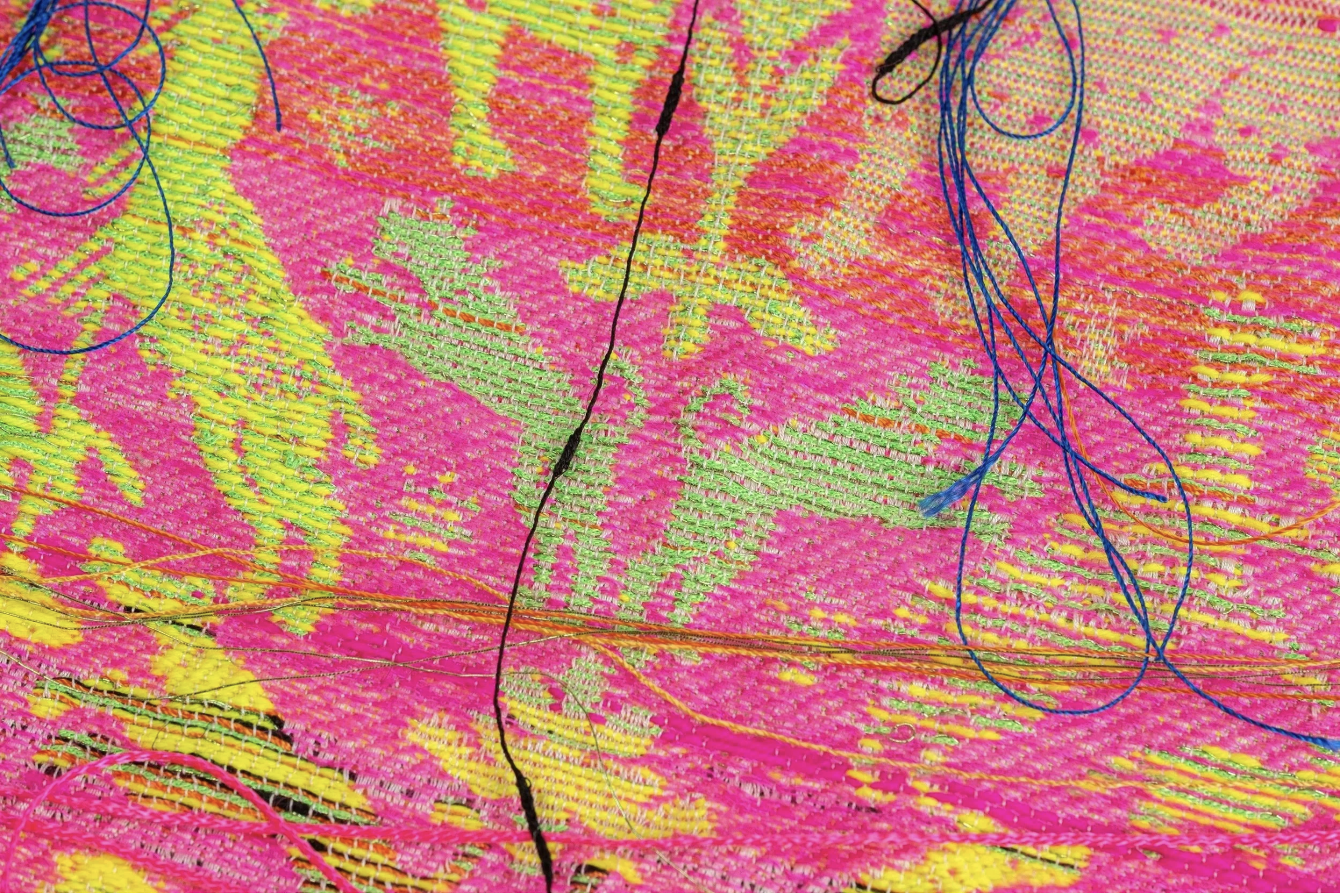
A horizontally oriented textile panel hangs against a plain white gallery wall. The surface is predominantly vivid pink with yellow-green woven motifs arranged symmetrically across the composition, including stylised animals, birds and plant forms. The fabric is disrupted by several horizontal openings that reveal underlying layers. Long loose threads in multiple colours hang from the edges and across the surface, some trailing downward in arcs. A narrow band of lighter pink fabric runs along the top edge. The frayed edges and exposed structure emphasise processes of weaving, cutting and unravelling. Raisa Kabir, Neon compound histories, 2024. Silk, wool, and synthetic yarns, 50 cm x 74 cm. Courtesy of Raisa Kabir and Indigo+Madder.